The definition
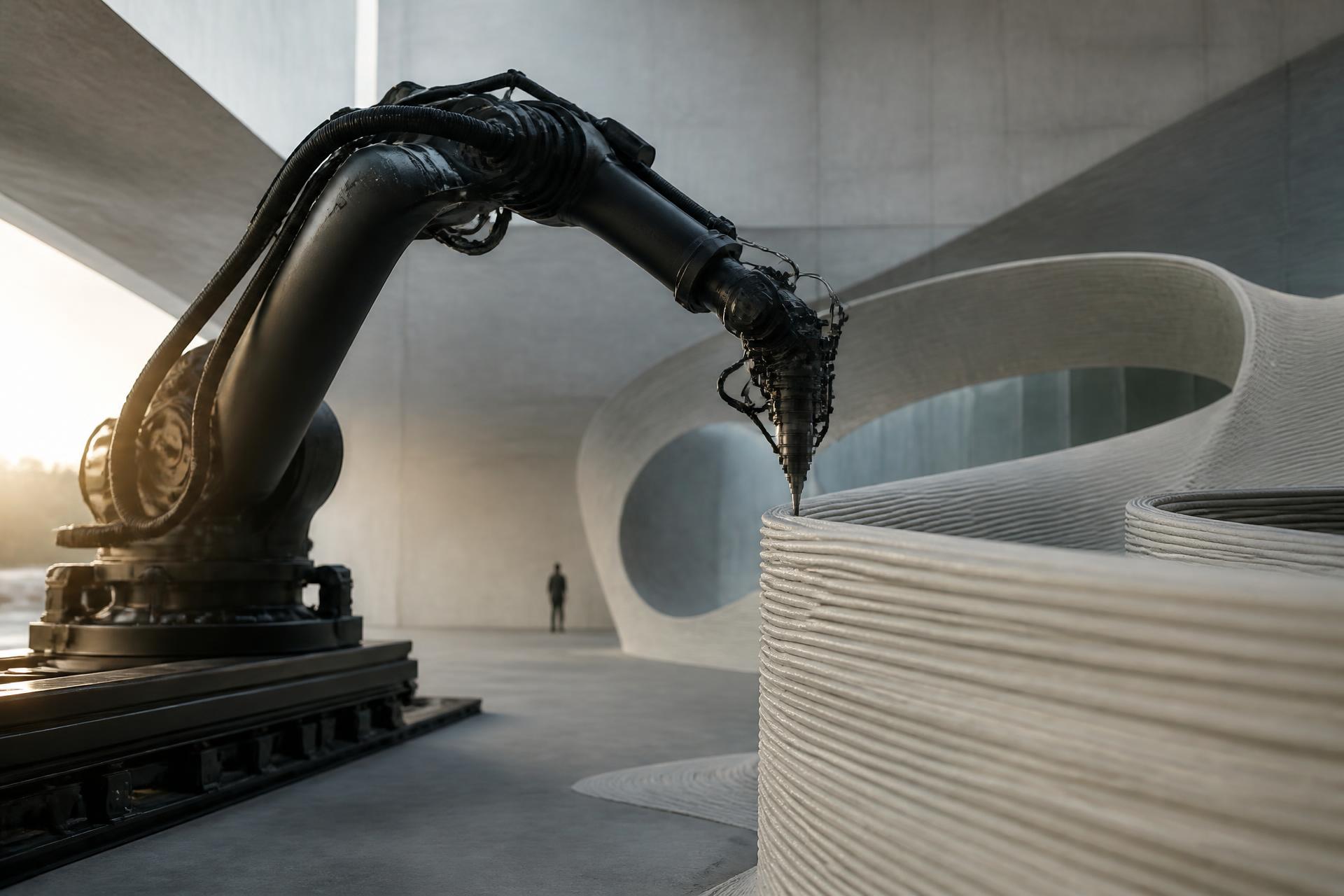
Large Format Additive Manufacturing describes any additive process capable of producing a single object at architectural scale in one continuous production run. The threshold isn't formal — but in industry practice, a system is considered LFAM when the print envelope exceeds roughly one cubic meter and the deposition rate is measured in kilograms per hour, not grams per hour.
The category exists because the economics of 3D printing change at scale. Below one cubic meter, desktop and mid-format systems compete with injection molding, CNC and casting. Above one cubic meter, LFAM competes with hand fabrication, GFRC casting and custom millwork — a very different economic frontier where geometry is the constraint, not tooling.
The process in five steps
1. Design: geometry is authored in a CAD environment (Rhino, Grasshopper, Houdini or a solid modeler) and prepared as a printable mesh or surface.
2. Toolpath: the geometry is sliced or authored directly as a robot toolpath — a sequence of coordinated moves in X, Y, Z and, for robotic systems, in orientation.
3. Simulation: the toolpath is simulated against thermal, structural and reachability constraints before any material is extruded.
4. Print: the extruder deposits a heated bead of polymer or composite bead-by-bead, layer-by-layer, at rates typically between 5 and 50 kilograms per hour.
5. Finish and install: the printed element is trimmed, sanded, coated or left as-printed, then crated for site delivery and installation.
Materials LFAM uses at scale
LFAM materials are pellet-fed rather than filament-fed. That change is what enables the deposition rate. Common families include recycled and virgin thermoplastics (PETG, ABS, PLA), fiber-reinforced thermoplastics (carbon and glass reinforced polymers for stiffness), mineral composites (cementitious systems for exterior and structural use), and bio-composites (cellulose, hemp, PLA blends for low-carbon builds).
Material choice is driven by application. Interior architecture typically uses recycled polymer for cost and finish; exterior architecture typically uses mineral composite for weathering; tooling typically uses fiber-reinforced polymer for stiffness and temperature resistance.
Common applications
Architecture: full-scale walls, ceilings, columns, façade panels, screens and interior features.
Tooling: composite layup tools, thermoforming molds, concrete formwork, foundry patterns.
Furniture and objects: contract seating, tables, lighting, sculpture, limited editions.
Scenic and experiential: public art, exhibition architecture, themed rockwork, film and TV set architecture.
Common questions
- How is LFAM different from 3D concrete printing?
- 3D concrete printing is a specific LFAM application using cementitious material. Polymer-based LFAM covers a broader range of applications including interior architecture, tooling and furniture.
- How fast is LFAM?
- Deposition rates typically run 5 to 50 kilograms per hour, which translates to full-scale architectural elements in hours to days rather than weeks.
- Does LFAM require expensive tooling?
- No — that's the primary advantage. LFAM produces one-off geometry without molds, dies or patterns.