
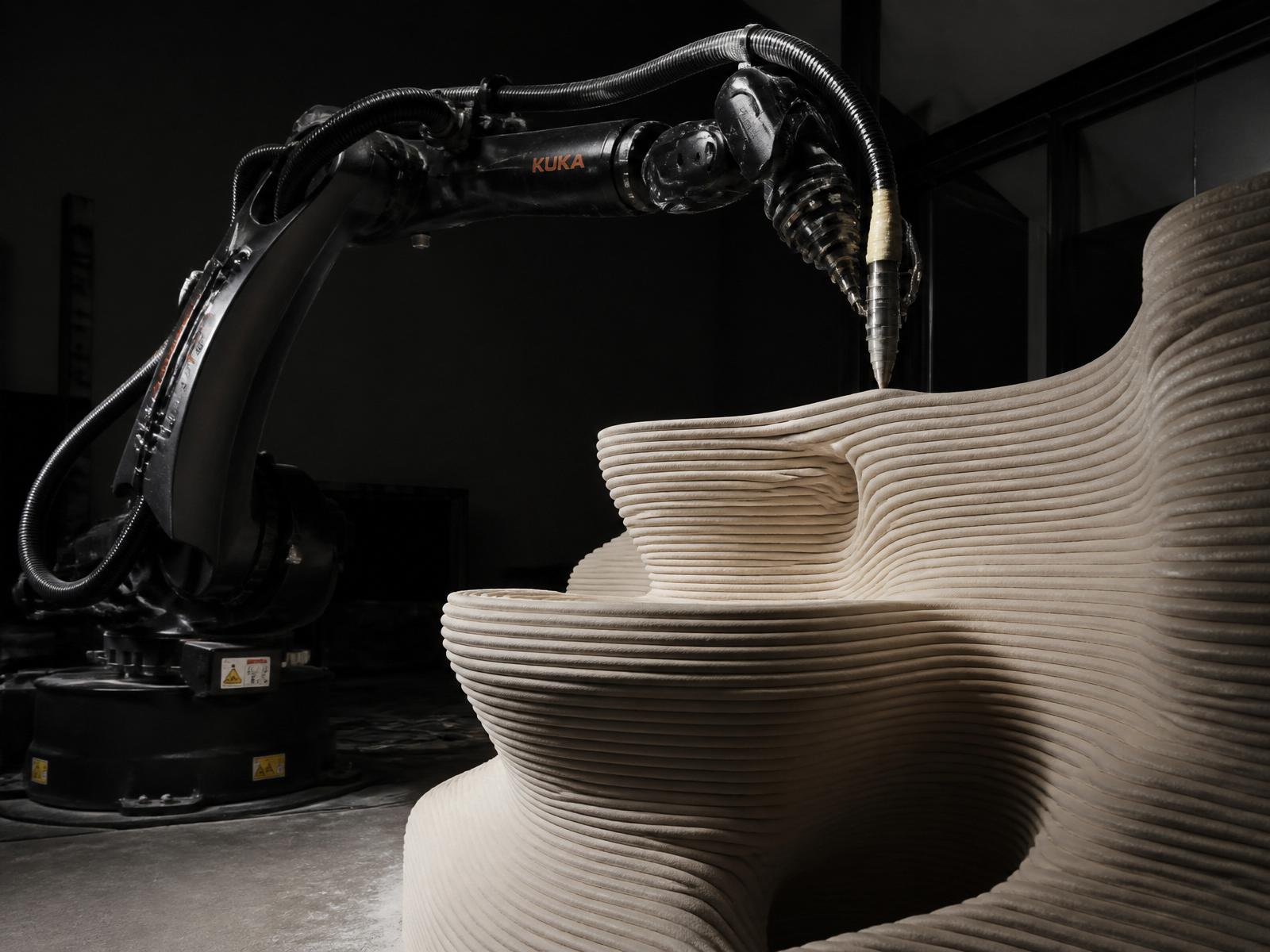
What LFAM actually means
LFAM is a subset of additive manufacturing (the technical term for 3D printing) defined by the size of the part it can produce in a single continuous run. Desktop 3D printers work in a few hundred millimeters. Industrial LFAM systems work in meters — typical print envelopes range from 2 x 2 x 2 meters to 12 x 6 x 6 meters, and multi-cell configurations can produce elements up to 40 meters long.
The category also implies a change in materials. Where desktop printers extrude a thin strand of plastic, LFAM systems extrude a thick pellet-fed bead of polymer, fiber-reinforced composite, mineral composite or bio-composite. That bead is what allows the process to scale — it deposits material fast enough to make architectural-scale printing economically viable.
How LFAM machines are built
There are two dominant hardware architectures. Gantry systems mount an extruder on a large X-Y-Z overhead frame — the classic industrial 3D printer scaled up. Robotic systems mount the extruder on a 6-axis industrial robot arm, which allows non-planar toolpaths, printing on angled surfaces, and continuous layers that follow the geometry rather than slicing it into flat horizontal cuts.
Robotic LFAM is the architecture LOOPFORM operates. It trades some vertical build height for radical geometric freedom — the ability to print curved cantilevers, spatial lattices and continuous forms that a gantry cannot reach.
What LFAM is used for
The commercial applications cluster into four families: architecture and interior features (walls, ceilings, columns, façade panels), tooling and molds (composite layup tools, thermoforming molds, concrete formwork), furniture and objects (seating, tables, lighting), and scenic / experiential (public art, exhibition architecture, themed environments, sets).
The unifying thread is geometry that traditional trades cannot economically produce — one-off, curved, or continuous forms where the setup cost of a mold, mill or hand-sculpt would exceed the value of the piece.
Where LFAM sits vs. traditional fabrication
LFAM is not a replacement for concrete, steel or millwork — it complements them. Where a project needs a repeating rectilinear panel, conventional fabrication wins on unit cost. Where a project needs a one-of-one sculptural form, LFAM wins on setup cost and lead time. Most real projects use both: LFAM for the signature moments, traditional trades for the field.
Common questions
- Is LFAM the same as 3D printing?
- LFAM is a category of 3D printing defined by scale — industrial systems that print in meters, using pellet-fed extruders and, often, 6-axis robotic arms.
- What materials can LFAM print?
- Recycled and virgin polymers, fiber-reinforced thermoplastics, mineral composites and bio-composites are the common material families.
- How large a single element can LFAM produce?
- Typical single-cell envelopes are 2 to 12 meters on a side. Multi-cell configurations can produce continuous elements up to 40 meters.