LoopForm
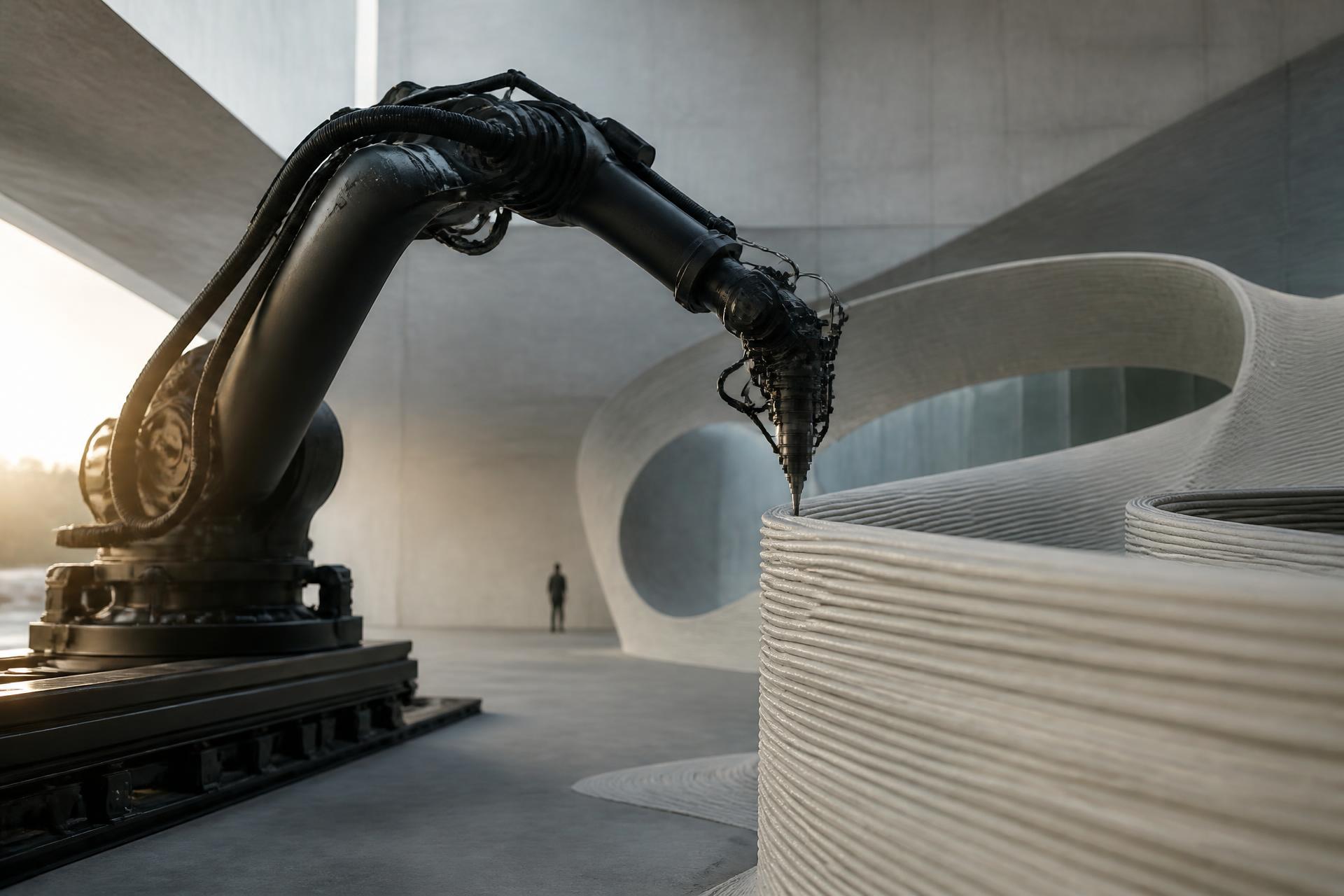
Robotic arm printing a large-format architectural element in LoopForm's Houston studio

Houston, Texas · Large-Format Robotic Manufacturing

Large-Format Additive Manufacturing in Texas

LoopForm is a Houston-based studio producing large-format robotic polymer and composite additive manufacturing for architectural features, facades, custom environments and industrial tooling — engineered, printed, finished and installed for projects across Texas.

Positioning

A specific kind of manufacturer.

“Additive manufacturing in Texas” covers several unrelated industries, so it is worth being precise about which one this is. LoopForm operates large-format robotic extrusion in polymer and fiber-reinforced composite. Parts are printed as continuous beads at architectural scale, then finished and installed as building-integrated or environment-scale elements.

That is not the same business as a metal WAAM or DED supplier, whose wire-arc and powder processes serve pressure-containing, structural steel and alloy components with welding-code qualification. It is also not a desktop or mid-format print bureau, where parts are measured in centimeters and the work is prototyping, jigs and small production runs. And it is not concrete house printing, which extrudes cementitious mix directly on a slab to form load-bearing walls under residential construction codes.

LoopForm sits between the architecture and industrial-manufacturing worlds: a fabrication partner for design and project teams who need geometry that conventional millwork, casting or metal fabrication cannot produce economically, at a scale desktop printing cannot reach. Read the longer technical background in What is LFAM and the trade comparison in LFAM vs CNC vs traditional fabrication.

What We Manufacture

Parts, environments and tooling.

Architectural walls & features

Feature walls, ceilings, columns, screens and sculptural elements printed as continuous forms rather than assembled from repeating panels, then engineered into modules that fit the shipping route and the site opening.

Learn more

Facades & envelope elements

Exterior-intent panels and envelope features where geometry, shading behaviour and depth are part of the design. Exterior suitability is confirmed per project with the material and coating supplier.

Learn more

Custom furniture & fixtures

Reception desks, bars, seating, tables and one-off fixtures produced without pattern-making or moulds, with finish developed on physical mock-ups before production.

Learn more

Retail & hospitality environments

Store architecture, brand activations, lobbies and lounges fabricated as a single coherent gesture instead of a package of unrelated trade scopes.

Learn more

Large-scale composite tooling & molds

Layup tools, trim and drill fixtures, thermoforming and vacuum-form tools, and master patterns printed near-net and machined to tolerance where the application requires it.

Learn more

Custom fabrication at scale

Exhibits, public and experiential pieces, and unusual one-off parts that fall outside standard millwork, casting or metal fabrication scopes.

Learn more

Why Robotic Additive

Where it earns its place.

Additive is not the right answer for every scope. It becomes the right answer when the geometry is complex, the quantity is low, the piece is large, and tooling would otherwise dominate the budget.

Geometry freedom
Curvature, variable thickness, undercuts and non-repeating geometry cost the same to print as flat and simple geometry. The design does not have to be rationalised down to what a mould or a panel system can produce.
Reduced tooling dependency
Because the part is deposited directly from the digital model, most projects need no pattern, no mould and no dedicated tooling. That removes an entire fabrication stage from the schedule and makes revisions a model change rather than a rebuild.
Domestic production
Parts are printed in Houston, Texas. Drawings, mock-ups, production and finishing sit in one facility, so review happens in person and the supply chain does not run through an overseas fabricator.
Integrated engineering, finishing & installation
Engineering coordination, printing, finishing and site installation are handled under one scope, which keeps accountability in one place from geometry through the installed piece.
Project-specific material selection
Material is chosen against the application — interior or exterior, loading, fire and code requirements, lifecycle, light behaviour and finish. There is no single default feedstock.

Industries Served

Sectors we build for.

The process transfers across sectors because the constraint it removes — tooling for complex, low-volume geometry — is common to all of them. Architecture, hospitality and retail projects arrive as design-led environments. Marine, aerospace and industrial tooling projects arrive as engineered parts, layup tools and thermoforming and composite fixtures, where the same near-net printing and machining workflow applies. Energy and defense enquiries are evaluated case by case against the same criteria: geometry, material suitability and documentation requirements.

All industries

Service Area

Made in Houston, delivered statewide.

Production is consolidated in one Houston facility. Design teams, general contractors and brand clients working anywhere in the state are served from there, and interstate highway access means finished modules reach Austin, Dallas–Fort Worth, San Antonio and the rest of Texas on a normal freight schedule.

Proximity matters most during development rather than delivery. Mock-ups, finish reviews and colour approvals are physical decisions, and being in-state means a project team can stand in front of the actual sample under the actual lighting instead of approving a photo. For projects beyond Texas, modules are crated and shipped, with installation supervision arranged as part of the scope.

Logistics are engineered alongside the geometry: segmentation, crate sizes, lifting points and site access are resolved in the model before printing starts, so the piece that leaves the studio can actually reach the space it was designed for.

End to End

Material, engineering, finish, installation.

Materials

Recycled polymer composites, fiber-reinforced thermoplastics, translucent and specialty formulations, and coating systems — selected against loading, exposure and code.

Materials library

Engineering

Print envelope, segmentation, tolerances and structural coordination with the architect of record and engineer of record for the project’s jurisdiction.

Technical specs

Finishing

As-printed, honed, sanded, coated or mass-pigmented finishes, developed on physical mock-ups and approved under project lighting before production.

Capabilities

Installation

Modules delivered with fixing strategy, lifting points and site sequencing resolved, with installation supervised by the team that printed them.

Our process

Questions

Common questions.

What is large-format additive manufacturing?
Large-format additive manufacturing (LFAM) is industrial 3D printing at architectural scale. Instead of a thin filament, a robotic arm extrudes a thick pellet-fed bead of polymer or fiber-reinforced composite, building parts measured in meters rather than millimeters.
What can LoopForm manufacture?
Architectural walls and features, facades and envelope elements, custom furniture and fixtures, retail and hospitality environments, large-scale composite tooling and molds, and one-off custom fabrication at scale.
Do you serve projects across Texas?
Yes. LoopForm manufactures in Houston and delivers to projects in Houston, Austin, Dallas–Fort Worth, San Antonio and statewide, with modules sized for the shipping route and site access.
Can LoopForm support engineering, finishing and installation?
Yes. Engineering coordination with the architect of record and engineer of record, finish development on physical mock-ups, and site installation are handled within one scope.
What materials can be evaluated?
Recycled polymer composites, fiber-reinforced thermoplastics, translucent and specialty formulations, and architectural finish and coating systems. Suitability is confirmed per project against loading, exposure and code requirements.

Send us the geometry. We’ll tell you if it prints.

A feasibility review covers printability, segmentation, candidate materials, finish direction and an honest read on schedule and budget range for your Texas project.

Request a Feasibility Review