
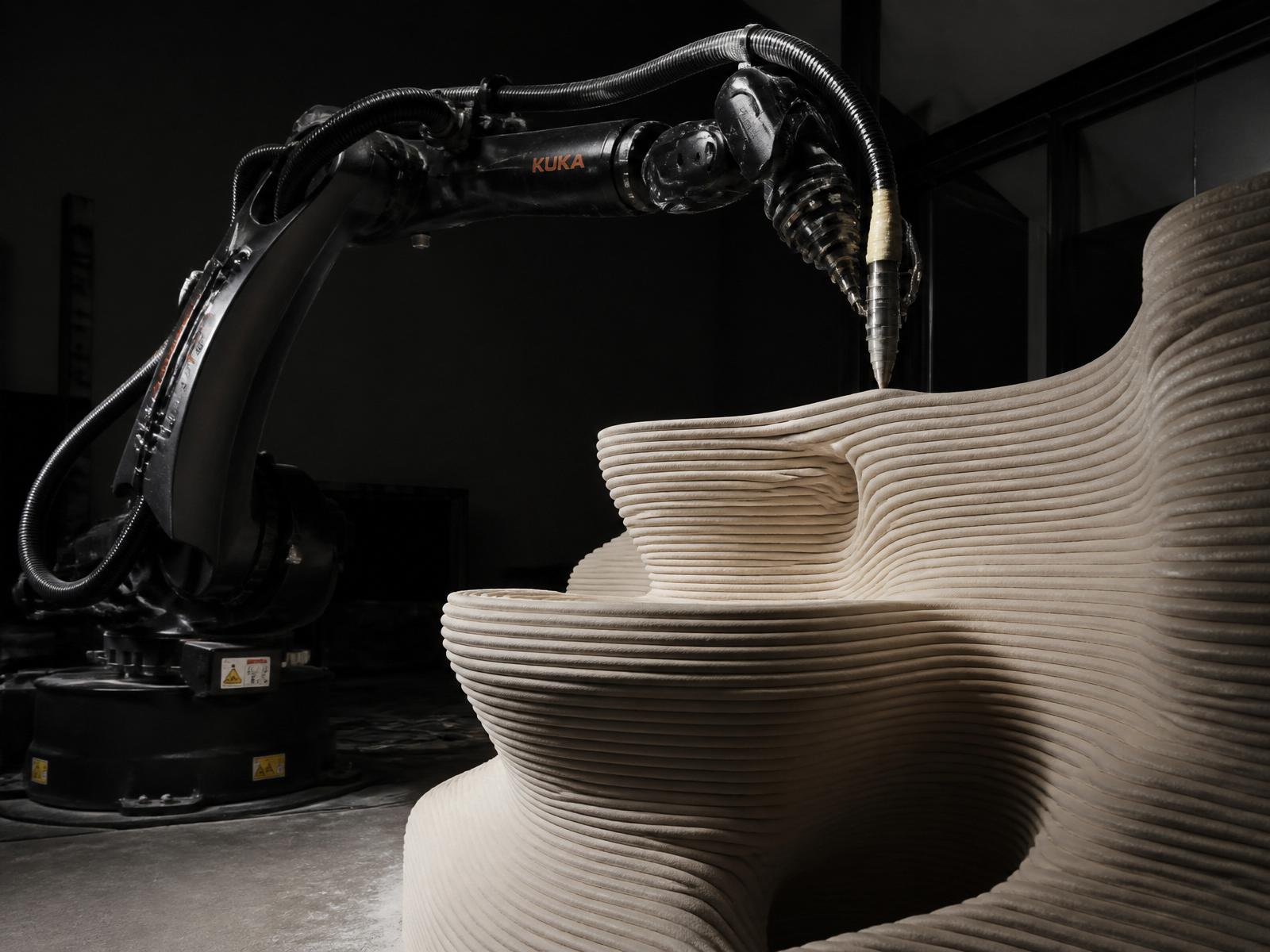
What each process is actually good at
LFAM (large-format 3D printing) is additive — it deposits only the material that ends up in the part. It wins on one-off curved geometry, hollow or ribbed forms, and pieces where the setup cost of a mold would exceed the value of the part.
CNC milling is subtractive — it removes material from a block to reach the final geometry. It wins on tight-tolerance flat and prismatic parts, hardwood and metal, and finishes that require the resolution of a small cutter.
Traditional trades (millwork, GFRC, metal fabrication, upholstery) win on repeatable rectilinear geometry with mature supply chains — anywhere the trade is doing what it's done for a century and unit cost has been driven down.
The decision framework
1. Is the geometry curved or one-off? If yes, LFAM is on the shortlist. If no, remove it.
2. Is the tolerance sub-millimeter over a large flat surface? If yes, CNC. Printed surfaces sit at roughly 0.5 to 1.5 mm layer-line tolerance before finishing.
3. Is the material a specification requirement (real hardwood, solid metal, cast concrete)? If yes, traditional trade. Printing simulates but doesn't replace those material identities.
4. Is the piece a one-off or a run under ~50 units? LFAM's no-mold economics usually win. Above that, GFRC / precast / injection molding typically undercut it.
5. Is the schedule compressed? LFAM removes the mold-making phase — often the deciding factor when the design ambition has to fit inside the construction schedule.
Hybrid programs are common
Most real projects use two or three processes together. A signature reception might be LFAM for the sculptural desk, CNC for the tight-tolerance stone top, and traditional millwork for the back-of-house cabinetry.
That's the mature specification: pick the process per piece, not per project. The fabricator who owns the LFAM scope should be comfortable coordinating with the CNC and millwork trades — it's the norm, not the exception.
Common mis-specifications
Specifying LFAM for a repeating rectilinear panel: GFRC will beat it on unit cost every time.
Specifying CNC for deep spatial geometry: the mill can't reach the geometry, and the material waste is untenable.
Specifying traditional millwork for a signature curved wall: the hand-labor cost balloons and the schedule slips.
Common questions
- Can LFAM hit the tolerances of a CNC mill?
- Not before finishing — printed layer-line tolerance sits around 0.5 to 1.5 mm. Post-finishing (sanding, coating) brings the visible surface tolerance in, but structural datum surfaces are typically machined.
- Is LFAM always more sustainable than CNC?
- On material waste, yes — LFAM waste is under 5% versus 40 to 80% for subtractive. On embodied carbon, the material choice matters more than the process.
- Who owns the process decision?
- The specialty fabricator recommends per piece, but the architect of record signs off — the decision affects submittals, warranties and site coordination.