
What's actually possible
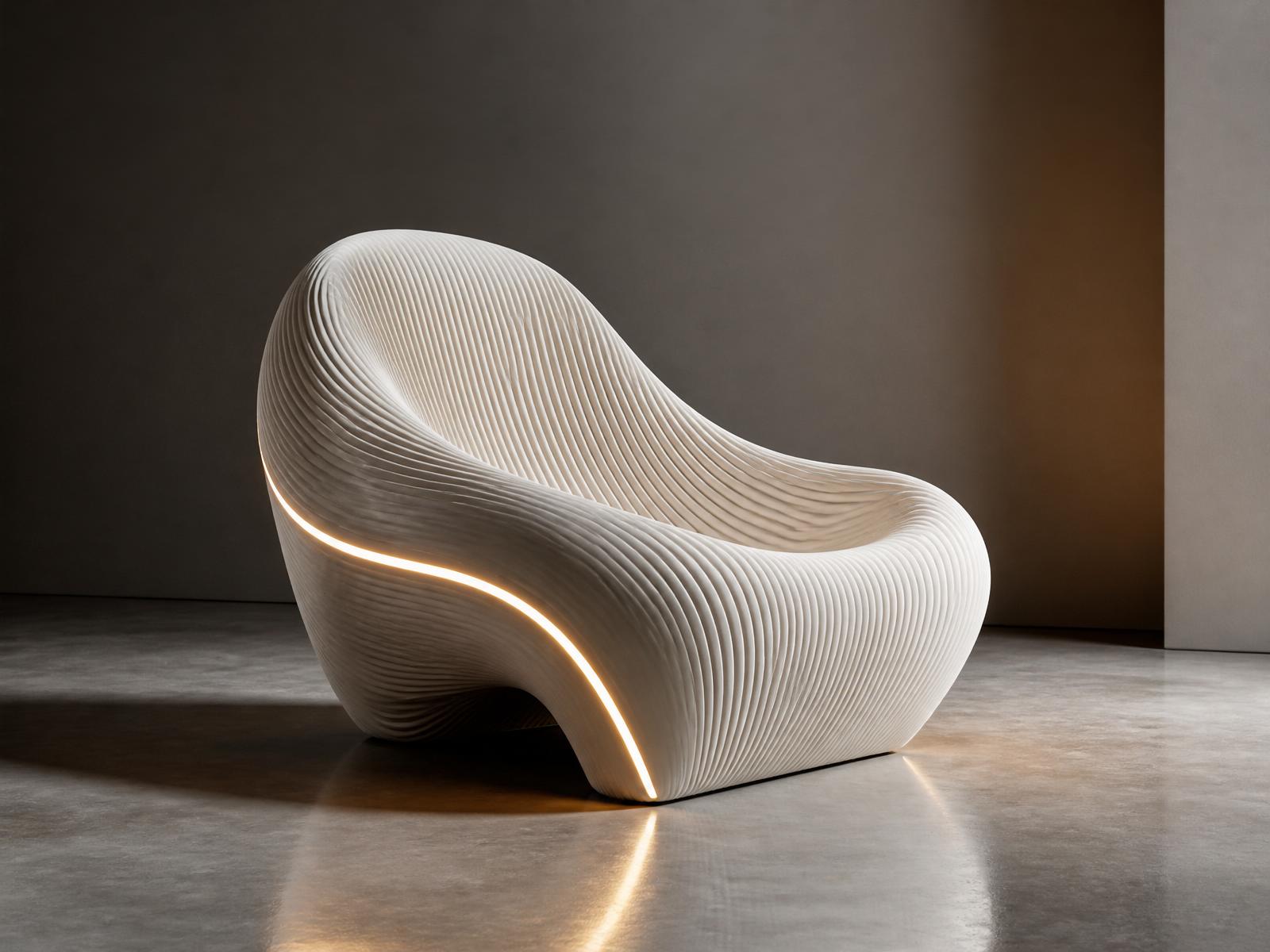
Contract seating: printed lounge chairs, benches, banquettes and stools produced as single objects in TPE (thermoplastic elastomer) for cushion-like softness or in rigid polymer for sculptural forms.
Tables and consoles: printed side tables, dining tables, reception counters and consoles — often with the base and top printed as one form.
Planters and vessels: printed at scales from tabletop to public plaza, in bio-composite or recycled polymer.
Lighting: printed shades and sculptural fixtures where the geometry doubles as the diffuser.
One-off vs. edition vs. contract
One-off pieces: bespoke commissions for private residences or hospitality — one piece printed to the client's spec.
Editions: numbered runs (typically 8 to 50 pieces) sold through galleries or brand programs.
Contract collections: repeatable furniture programs for hospitality operators, corporate campuses or retail — printed to a per-project count on the same finish protocol.
Lead times and pricing
Bespoke commissions typically run 4 to 10 weeks from approved geometry. Editions run to the same timeline per piece. Contract collections align with the property's construction schedule.
Pricing is a function of geometry, material and finish — a printed lounge chair in TPE typically sits in the same price band as a designer contract chair from a major manufacturer. Larger sculptural pieces price accordingly.
Care, warranty and end-of-life
Every piece ships with a care and warranty document — cleaning agents, refinishing intervals, and warranty against manufacturing defects.
For pieces printed in closed-loop recyclable material families (recycled PETG, certain bio-composites), the fabricator can take the piece back at end of life and reprocess it into feedstock. That end-of-life pathway is worth confirming at specification, especially for hospitality operators with sustainability charters.
Common questions
- Can printed furniture be comfortable to sit on?
- Yes — TPE (thermoplastic elastomer) printed at scale gives a cushion-like softness without upholstery. Rigid polymer pieces use geometry (ribs, lattices) to introduce give.
- How does printed furniture compare on price to designer contract furniture?
- A printed lounge chair typically sits in the same price band as a designer contract chair — larger or more sculptural pieces price accordingly.
- Can pieces be cleaned like conventional furniture?
- Yes — cleaning protocols are provided per piece, tuned to the material family. Most polymer families accept standard commercial cleaning agents.